
The Taliban in the Middle
Every corridor India has tried to build to Central Asia runs past Afghanistan. It is the one neighbour that can neither be gone through safely nor gone around cheaply.
The map of India's connectivity ambitions has a hole in the middle of it, and the hole is Afghanistan. The short route to Central Asia runs through Pakistan, which is closed to India; the route India built instead runs through Iran, which is now at war; and between Iran and the Central Asian republics sits Afghanistan: landlocked, mountainous, and since 2021 governed by a Taliban administration that India spent two decades keeping at arm's length. There is no version of the overland map in which Afghanistan does not appear, and no version in which it is simple.
India once had more of a foothold here than it does now, and it is worth being honest about how much has been lost. It built the Zaranj–Delaram road in Afghanistan's south-west, precisely to link Chabahar to the Afghan ring road and onward to Central Asia, bypassing Pakistan entirely. It kept a presence around the Ayni and Farkhor airbases in Tajikistan, on Afghanistan's northern edge. Much of that footprint thinned after 2021, and India has since been running a careful, deniable, low-altitude relationship with a Taliban government it does not recognise but cannot ignore, while its trade with Afghanistan, close to a billion dollars and much of it routed through Chabahar, depends on exactly the corridors the 2026 war has now thrown into doubt.
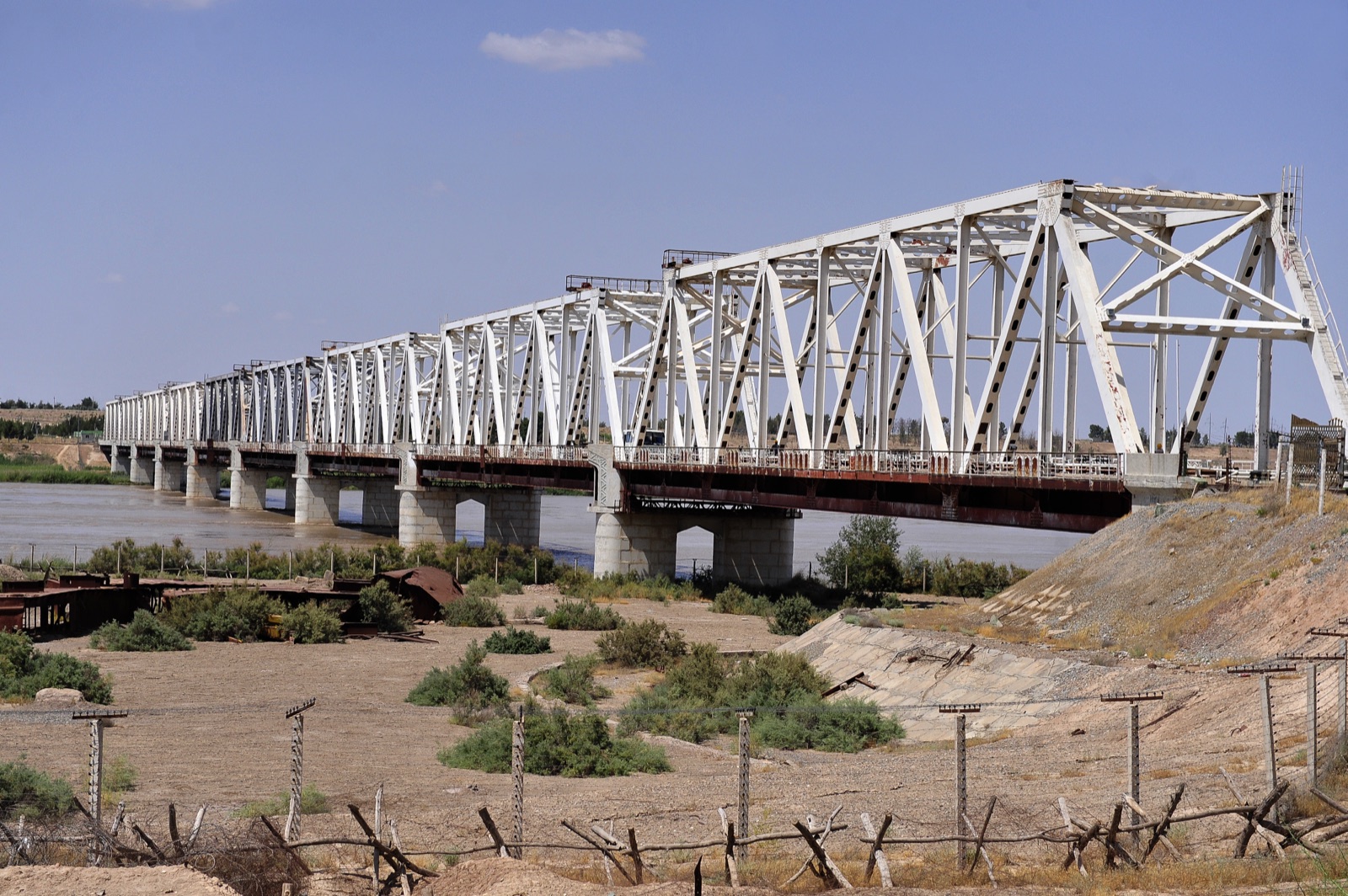
The country that has read this situation most clearly is not India but Uzbekistan. Termez, on the Uzbek bank of the Amu Darya, has quietly become the logistics capital of the Afghan question: a railhead, a trans-shipment point, and now a node in the international relief network that feeds Afghanistan. The Friendship Bridge that crosses the river there, thrown up by the Soviets in 1982 to carry an army in, now carries the slow and contested traffic of a region trying to keep Afghanistan stable enough to trade with. Whoever holds the approaches to Afghanistan holds a large share of Central Asia's southern options, and at the moment that is Tashkent and, increasingly, Islamabad, not Delhi.
Pakistan has noticed the opening. Its proposed Uzbekistan–Afghanistan–Pakistan railway, costed at around 4.8 billion dollars, is an explicit bid to make Pakistan the road from Central Asia to the sea, with Afghanistan as the middle section. I am not saying it will be built on schedule, because the Afghan–Pakistan border is among the most violent in the region, the Tehreek-e-Taliban has turned Khyber Pakhtunkhwa into a near-permanent insurgency, and Kabul and Islamabad spend as much time threatening each other as trading. But the ambition is real, and it is aimed squarely at the space India vacated.
A corridor that depends on Afghanistan is like a lease that depends on the goodwill of a tenant who has burned down the last two buildings. The location is perfect; that is exactly why everyone keeps signing. The risk was never in the address but in the occupant, and no amount of paperwork makes the occupant predictable.
India's response has been to treat Afghanistan less as a market and more as a security problem to be managed jointly with the Central Asians, which is probably the right instinct. The India–Central Asia framework now runs a standing dialogue between national security advisers; India and Kazakhstan hold the KAZIND counter-terrorism exercises; and the joint statements return, again and again, to terrorism, radicalisation and the drug trade flowing out of Afghan territory. The Pahalgam attack of 2025 hardened that language further. Connectivity and security have become the same conversation, because in this part of the map they are the same problem.
I am not saying India can solve Afghanistan, because no outside power has, and the graveyard of that ambition is well populated. I am saying that India cannot reach Central Asia by pretending Afghanistan is not in the way. Every route runs past it. The question India has dodged for twenty years, what kind of relationship it is willing to keep with whoever rules in Kabul, is no longer an Afghan question. It is a Central Asian one.