The Last Door
With the Iran route at war and the Russia route under sanctions, the only clean overland path out of Central Asia is the Trans-Caspian Middle Corridor. It runs east to west. India needs north to south. That single mismatch is the whole problem.
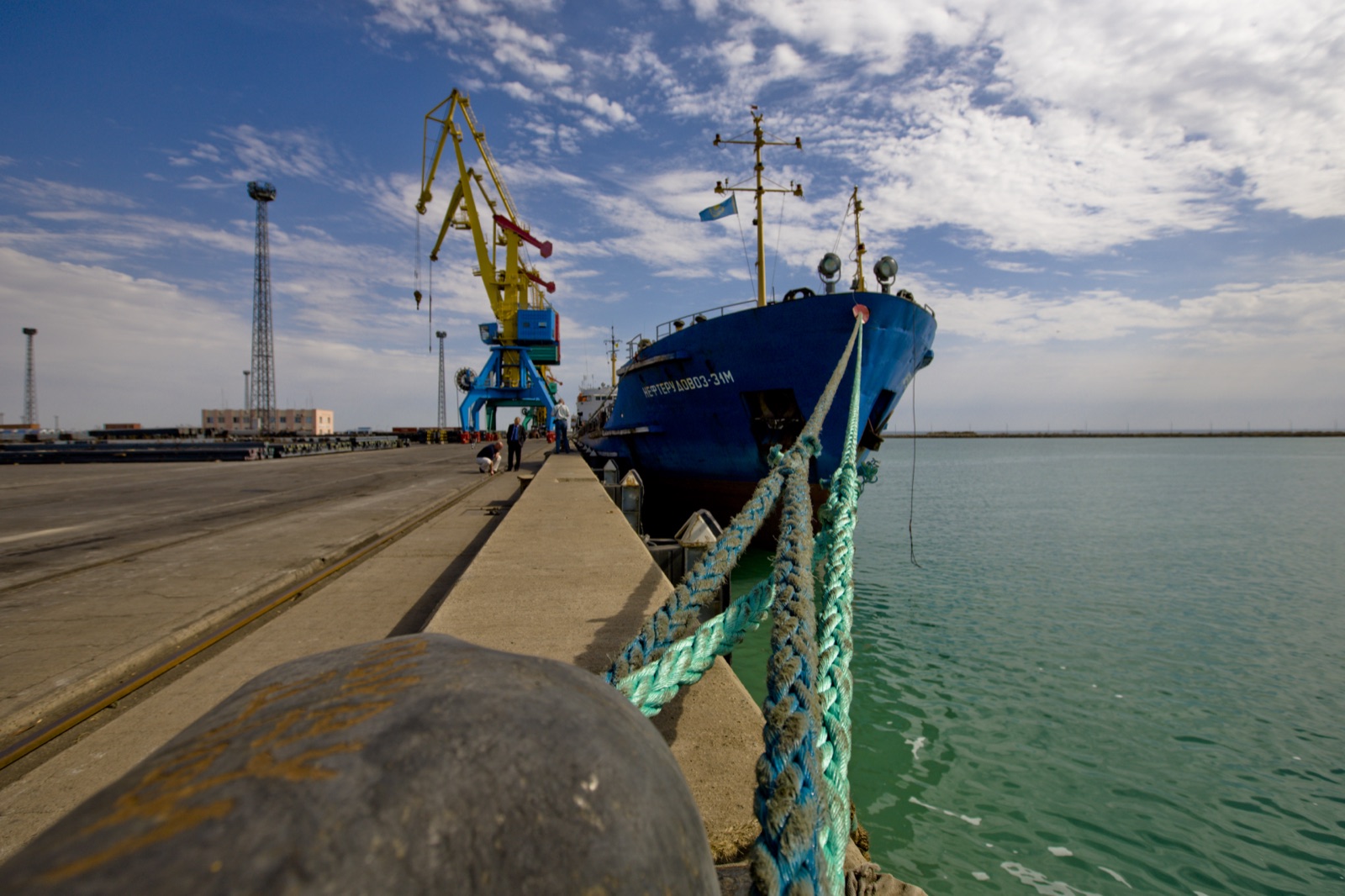
The most important fact about the Middle Corridor, seen from Delhi, is the direction it runs. With the southern route through Iran severed by war and the northern route through Russia compromised by sanctions, the Trans-Caspian International Transport Route is the last overland corridor out of Central Asia that touches neither a battlefield nor a sanctions list. It has become, accordingly, the route everyone now wants to talk about. India's difficulty with it is essentially geometric. The Middle Corridor runs east to west, from China across Kazakhstan, over the Caspian, and through the Caucasus and Turkey into Europe. India's entire connectivity effort runs north to south, up from the Indian Ocean through Iran into the Central Asian underbelly. The two corridors meet at right angles, and one cannot simply turn left onto a motorway that has no southern on-ramp.
The distinction is worth drawing carefully, because the two routes are often confused. India's corridor, the INSTC, has three branches, and all of them are answers to the same question: how to reach the sea through Iran. The eastern branch runs by rail through Kazakhstan and Turkmenistan to Iranian ports, and is the one India began using in earnest in 2025. The central branch crosses the Caspian directly but has never had enough ships. The western branch, along the Caspian's far shore, still waits on an unfinished stretch of railway between Rasht and Astara. Different routes, same destination: every one of them comes out in Iran. And none of them runs as cleanly as a map implies, because the railways of the former Soviet states are laid to a broad gauge of 1,520 millimetres while Iran's run on the 1,435-millimetre standard, so somewhere near the border every container has to be craned off one set of bogies and onto another. A corridor with a gauge break in the middle is a corridor with a toll booth in the middle. The Middle Corridor is a different animal altogether, developed largely under the Organisation of Turkic States, and its entire purpose is to avoid both Russia and Iran by running sideways across the map. That is exactly what makes it useful today, and exactly what makes it awkward for India.
On its own terms, the Middle Corridor is performing better than anyone had a right to expect. Volumes have risen every year since the Ukraine war made the Russian route radioactive. The Gulf had committed more than 16 billion dollars of sovereign wealth to Central Asian logistics, energy and banking before this latest war, and Kazakhstan, as a net oil exporter, is one of the few economies in the region for which higher prices are a windfall rather than a wound. The trouble, for India, is whom the corridor was built to serve. Something like 80 percent of Chinese exports to Europe already transit Kazakhstan, and a route optimised to move Chinese containers to Hamburg does very little for a country sitting to the south of the entire arrangement.
This matters more now because of what India has started asking Central Asia for. The June 2025 India–Central Asia Joint Statement put rare earths and critical minerals near the centre of the relationship, and the first India–Central Asia Rare Earth Forum had met in Delhi the previous September. The prize is real: Kazakhstan alone is estimated to hold some 5,000 mineral deposits, has identified well over a hundred rare-earth sites while exploring only a fraction of them, and produces around 40 percent of the world's uranium. The problem is equally real. China controls roughly 60 percent of global rare-earth mining and something close to 85 percent of the processing, which is precisely the dependence India is trying to escape, and most of Central Asia's minerals currently flow to China for processing in any case. Critical minerals are not pharmaceuticals; one cannot air-freight a supply chain for them and treat the corridor as optional. To get the minerals out at scale you need the route, and the only war-proof route runs the wrong way for India.
The capital tells the story more honestly than the communiqués do. The oil-importing economies of the region, Tajikistan and Kyrgyzstan in particular, are taking the price shock straight into inflation and freight costs. Kazakhstan banks the export revenue, but even Astana is being pushed around: Washington imposed a 25 percent tariff on Kazakh goods in 2025, and tariffs of that kind tend to nudge a country toward the neighbour that is not imposing them. China has already invested in something like two hundred projects in Kazakhstan worth tens of billions of dollars, and it is the region's largest trading partner. So the corridor everyone is now racing to use is tilting, slowly, toward the one power India most wants to balance, while India stands to the south without a clean way in. Money does not move toward closed routes; it pools at the open ones, and at the moment it is pooling along an east–west line that runs past India rather than toward it.
There is one thread worth pulling. The same June 2025 statement recorded Kazakhstan's initiative to develop an eastern branch of the INSTC, and an eastern branch is the closest thing on the table to a hinge between the north–south corridor India built and the east–west corridor that is actually open. I am not saying a branch line redraws the map, because it does not. But it is the one place where India's geometry and Kazakhstan's geography could be made to meet, and it is precisely the kind of unglamorous connective detail that gets ignored until the day the main route closes, which is to say, now.
India is in the position of a shop that built its only loading dock on the back lane, because the back lane was quiet and cheap and nobody else was using it, and has since discovered that the whole city's traffic has been rerouted onto the main road at the front, where the shop has no door. The goods are still there. The customers are still there. The dock is simply facing the wrong way.
I am not saying India can plug into the Middle Corridor easily, because the geometry is genuinely against it, and the natural southern connector is a spur back down through Iran, which is the problem we began with. But it does not make a lot of sense to keep treating the Middle Corridor as somebody else's infrastructure when it is fast becoming the only infrastructure there is. The second India–Central Asia Summit was meant to happen in 2025. It did not. Every other door has shut. India is still feeling for the handle on this one.